Moreco / R&D + I / Moreco Research & Development
Since 2012, Moreco has been developing and testing its silicon-based solutions under real-world conditions, in collaboration with Moroccan growers and official institutes.
215
Trial campaigns worldwide
24
Campaigns documented in Morocco
37
Result sheets
2012
First campaign
Innovation
Innovation in the service of agricultural performance
At Moreco, innovation shapes the future of agriculture. Since 2012, we have been investing in a targeted way in the development of high-quality biotechnological solutions. With our R&D experts and partners, we design and optimise advanced formulations that contribute directly to your profitability. Our priority is to achieve maximum agronomic efficacy, superior uptake by crops and a proven improvement in harvest quality. In close collaboration with innovative growers and leading research institutes, we test and refine our products under real-world conditions. Thanks to this rigorous quality-control process, we guarantee consistent performance and reliable results in the field.
Need a custom formulation or product?
Are you looking to develop a specific product, or a formulation suited to your agronomic needs?
Whether it is a solution for your own crops or an innovative product to be marketed and distributed, our R&D team supports you through the design and development of tailor-made solutions.
We study your needs and work with you on formulations suited to your technical and agronomic objectives.
Would you like to develop a solution with Moreco?
Our team is available to study your project and explore the possibilities for collaboration.
Scientific publication
The studies and the scientific interview our formulations rest on, free to download.
- PDF · 94 KBThe importance of siliconInterview with Prof. Dirk Van den Berghe
- PDF · 484 KBImpact of agriculture on the Si biogeochemical cycleThe cycles of C and Si are closely related to the weathering of silicates. In both cycles, terrestrial plants make significant contributions to the weathering budget and soil formation. The perturbation of the terrestrial Si cycle by human occupation has become a challenging issue because of possible impact on the equilibrium of aquatic ecosystems and agriculture sustainability. The recycling of Si stored in plants as phytoliths may control the Si cycle in the short-term. A review of the recent literature shows that the biogeochemical cycling of Si that is generally not impacted by atmospheric input or fertilisation, is significantly altered by agriculture through the depletion of the phytoliths pool.
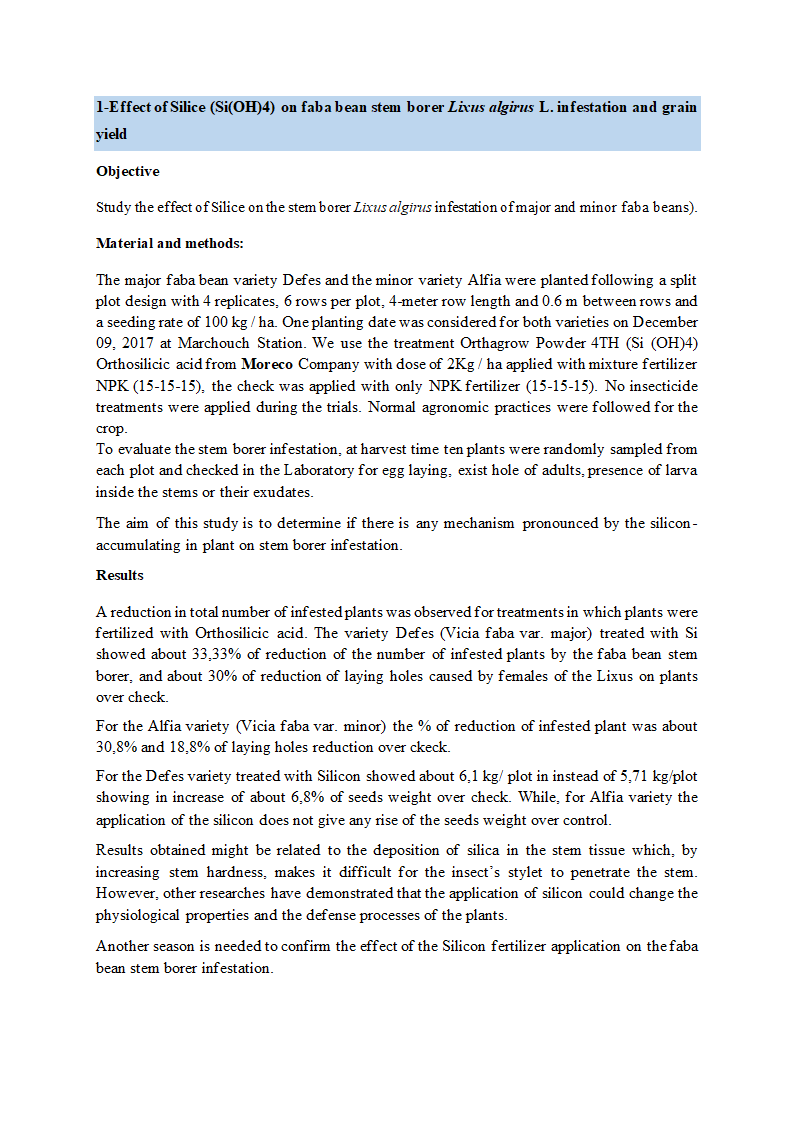
- 2017–2018 seasonPNG · 41 KBEffect of Silice (Si(OH)4) on faba bean stem borer Lixus algirus L. infestation and grain yieldICARDA Rabat — Marchouch Station
- 14–16 May 2009PDF · 625 KBLe Silicium ; le levier minéral indispensable pour une agriculture durable au MarocBouzoubaâ Z., Ait Lhaj A., Mimouni A. — INRA-CRRA Agadir. Symposium international AGDUMED, Rabat
- 8–10 March 2005PDF · 746 KBEffect of Silicon on the improvement of wheat germination in salt and drought conditionsBouzoubaâ Z. — INRA Agadir. Symposium International sur le Développement Durable des Systèmes Oasiens, Erfoud