

News of the week
The physiological impact of heat stress on cell-wall integrity, and the biochemical counter-attack of orthosilicic acid
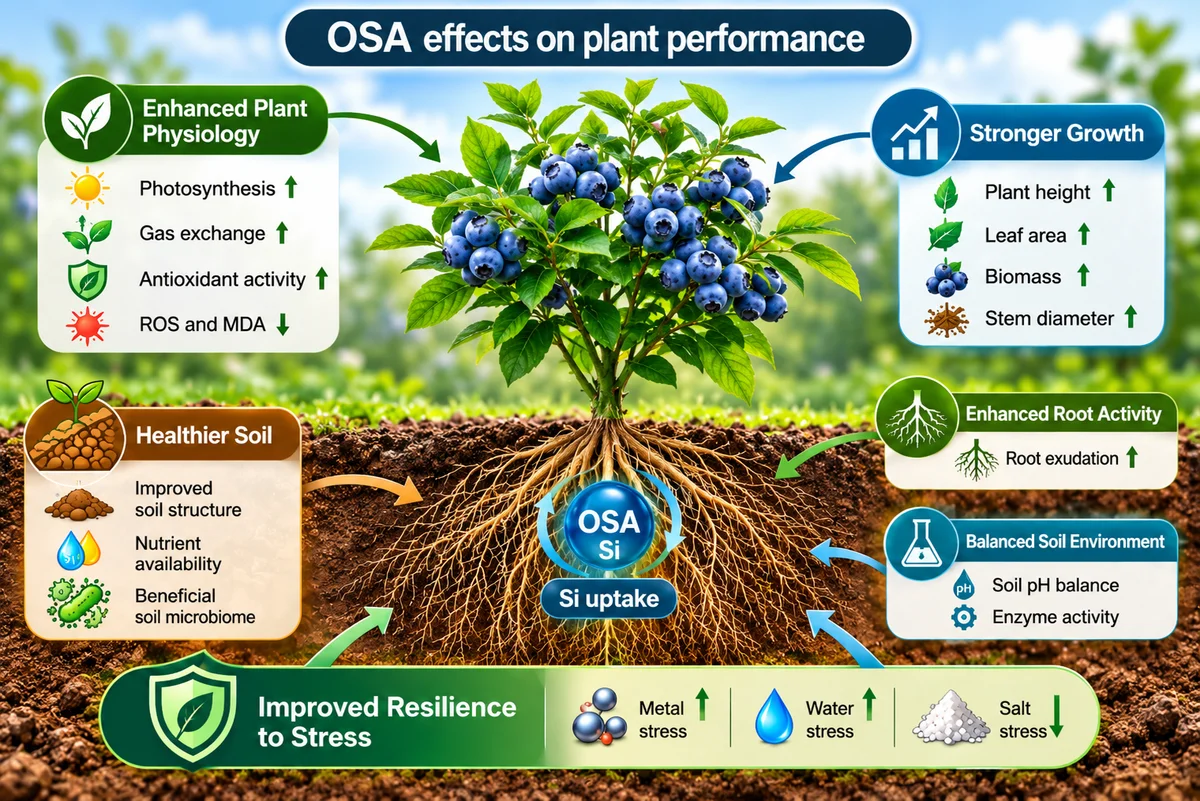
In protected and soilless cultivation, heat stress and micro-salinisation cause cell damage that is invisible but highly destructive. At the root of this physiological decline lie two crucial biochemical parameters: reactive oxygen species (ROS) and malondialdehyde (MDA).
ROS and MDA: the destructive cellular cascade
Under abiotic stress, the plant's homeostasis is disrupted, leading to an excessive build-up of ROS (reactive oxygen species). This overproduction causes acute oxidative stress that directly attacks the structural lipids of the membranes (lipid peroxidation). MDA (malondialdehyde) then appears as the cytotoxic biomarker of this damage. Rising MDA levels correlate directly with widespread membrane leakage, a sharp drop in photosynthetic efficiency and premature programmed cell death (apoptosis).
How orthosilicic acid (OSA) works
Although silicon is abundant in the soil, the plant can physiologically absorb it only in its bioavailable form, orthosilicic acid (OSA). Our unique, globally patented formula – certified and recognised on the market under the Orthagrow brand – reverses this destructive ROS/MDA dynamic at cellular level through three specific pathways:
- Antioxidant ROS scavenging: it activates and amplifies the plant's own enzymatic activity of major antioxidants (SOD, CAT and POD) to neutralise free radicals before lipid peroxidation begins.
- Lower MDA and membrane stabilisation: by sharply lowering the MDA index, membrane integrity is preserved. The plant keeps its water status and mineral balance under strong evapotranspiration pressure.
- Mechanical cuticle barrier: once absorbed, silicic acid polymerises as amorphous silica directly beneath the cuticle (silica armour). This functional barrier minimises non-stomatal cuticular transpiration.
Crop-specific quality gains
In commercial cherry tomato production, Orthagrow secures cell-wall elasticity and turgor pressure, significantly reducing cuticular micro-cracking and flower abortion under high osmotic pressure.
In soft fruit – the highbush blueberry (Vaccinium corymbosum L.) being a prime example – the formula effectively makes up for the chemical inertness and lack of bioavailable silicon in coco substrate. As the blueberry is naturally a poor silicon accumulator, the crop responds exceptionally well to Orthagrow's directly absorbable OSA.
Under cover, high relative humidity frequently triggers latent infections of Botrytis cinerea (grey mould). Our patented Orthagrow formula reduces the incidence of Botrytis by stimulating the plant's own defence pathways (increased PAL activity). The strengthened epidermal cells form a physical barrier that limits the penetration of fungal spores, while the firmer skin slows post-harvest respiration and extends shelf life.
Orthagrow's impact on quality and yield, in figures
Large-scale international field trials and academic research (including publications in MDPI Agronomy and FAO/ResearchGate) show concrete, measurable results:
- Total yield: an increase of +11% to +22% in biomass (on average 114 grams of extra fruit per plant per season) thanks to better uptake of nitrogen (N), phosphorus (P) and potassium (K).
- Fruit size: the average fruit diameter increases by 0.5 to 1.1 mm, moving a markedly larger share of the harvest into the top commercial grades (Jumbo/Premium).
- Export quality: more fruit classified as Category 1 Export, reaching 89% to 94% (against 78% to 82% under standard management), through a drastic reduction in grading rejects.
- Fruit firmness: +15% to +25% elasticity. The berries keep their firm texture 36 to 54 hours longer at room temperature, improving their resistance to mechanical shocks during harvest and transport.
- Storage and cold chain: shelf life extended by 3 to 7 days. The formula strengthens the natural waxy bloom and cuts weight loss from dehydration in transport by 10% to 25%, preventing shrivelling.
- Flavour and sugars (Brix): +0.5 to +1.2 points on the Brix index through a higher total soluble solids (TSS) content.
- Post-harvest fungal losses: in 14-day transport simulations, the packhouse rejection rate due to Botrytis or rot falls from 12%–16% to just 3%–5%.
The financial case and ROI (per hectare, export market)
The following techno-economic calculation is based on a reference crop of 15,000 kg/ha and an average export price of 49 Moroccan dirhams (MAD) per kg.
- Investment cost (OSA): MAD 1,300 to 2,700 for a full seasonal programme (4 to 6 applications by foliar spray or fertigation).
- Marketable yield gain: +MAD 88,200, based on a minimum increase of +12% in Category 1 fruit (+1,800 kg/ha).
- Savings on grading rejects: +MAD 11,000 to 16,000 from a 10% to 15% reduction in fruit rejected for cracks or malformations.
- Avoided quality disputes: +MAD 5,000 to 10,000 by eliminating price deductions or rejections at inspection by European supermarkets.
- Total additional gross margin: MAD 88,000 to 104,000 net gain per hectare after deducting the cost of inputs.
- Return on investment (ROI): from 30:1 to 45:1. Every MAD 100 invested in the Orthagrow programme generates between MAD 3,000 and MAD 4,500 of additional net profit.
Thanks to Orthagrow's unique, globally patented molecular stability, growers get the highest OSA bioavailability on the market through Moreco. That means an immediate physiological and financial lead in a highly competitive export market.