

News of the week
Seaweed and silicon: the winning duo to strengthen your crops and energise your soils
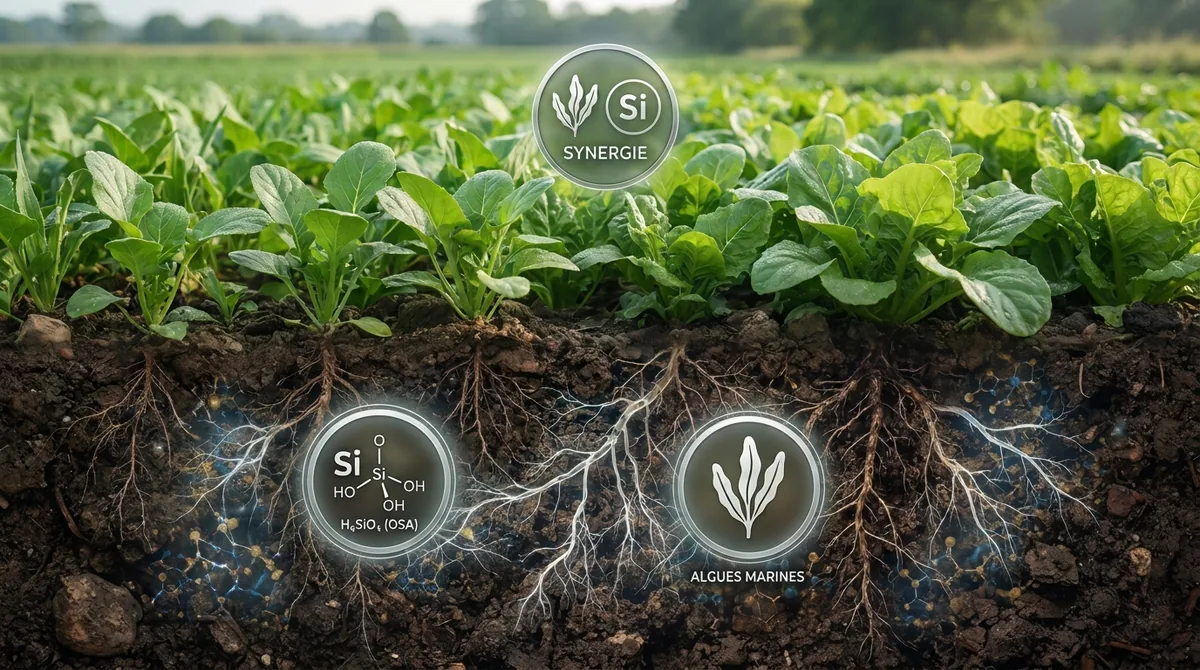
In modern agriculture and horticulture, finding sustainable levers to stimulate plants’ natural defences has become a priority. Among the available solutions, two biostimulants stand out: seaweed extracts and silicon (Si). While each has long proven its worth on its own, recent agronomic work shows that it is applying them together that creates a real synergy — both on plant physiology and on the soil’s microbial activity.
A dual action: physical barrier and metabolic engine
When seaweed extracts are combined with silicon, their modes of action complement each other perfectly. On the one hand, plant-available silicon is deposited in the plant’s cell walls. There it forms a mechanical barrier that strengthens tissue rigidity, limits leaf transpiration and improves the plant’s tolerance to abiotic stress (drought, high heat) as well as to pest and disease pressure.
On the other hand, brown seaweed extracts (such as Ascophyllum nodosum) act as a true physiological engine. Rich in amino acids, alginates, fucoidans and natural phytohormones, they stimulate chlorophyll synthesis, optimise photosynthesis and energise the plant’s whole metabolism. The result is visible in the field: vegetative growth speeds up, stem diameter increases and leaf biomass gains in vigour.
A valuable lever for mycorrhizal colonisation
The other major benefit of this combination plays out in the rhizosphere, with arbuscular mycorrhizal fungi (AMF). These micro-organisms form a symbiosis with the root system and spread a vast network of hyphae, greatly multiplying the volume of soil explored to capture water and poorly mobile mineral nutrients.
The seaweed–silicon synergy speeds up this natural symbiosis. The bioactive compounds in seaweed (flavonoids in particular) promote spore germination and steer hyphal growth towards the roots. At the same time, thanks to increased photosynthetic activity, the plant produces more carbohydrates to feed these symbiotic fungi. This energy exchange makes the rhizosphere markedly more active and functional.
Optimising water and mineral nutrition without exhausting the plant
With a well-mycorrhized root system and strengthened cell walls, nutrient uptake becomes more efficient. In particular, a significant increase in potassium (K) content is observed in the aerial parts — an element essential to osmoregulation, tissue firmness and the commercial quality of the harvest.
Because the plant spends less energy building root biomass in search of water and nutrients, it can reallocate its resources to above-ground growth and yield formation.
Why the choice of silicon formulation matters
Not all silicon sources offer the same bioavailability or the same agronomic safety. Conventional forms, such as silicate salts (sodium silicate), carry a major risk: applied at high rates, they can alkalinise the soil (raising the pH) and lead to a phytotoxic build-up of sodium (Na) in plant tissue.
To overcome these limits, modern formulations such as Orthagrow ALGA +SI 4G combine directly assimilable bioactive silicon with a pure Ascophyllum nodosum extract. The crop thus gets the full benefit of this synergy between metabolic biostimulation and cell reinforcement, with no risk of salinisation or physico-chemical imbalance in the soil.
Conclusion
Combining seaweed extracts with bioactive silicon (OSA) is a coherent, proven agronomic strategy. While seaweed stimulates plant metabolism and soil microbial life, silicon consolidates cell architecture and optimises the water and mineral balance. For growers, it is a high-performing tool for securing crops that are more vigorous, more resilient and more consistent.