

News of the week
Sustainable phosphorus management in Morocco: up to 89% more uptake thanks to the agronomic synergy of orthosilicic acid (OSA) and mycorrhizae
At the sixth European Sustainable Phosphorus Conference (ESPC6) at Mohammed VI Polytechnic University (UM6P) in Morocco, more than 300 international scientists, policy-makers and experts are gathering around a major question: how can phosphorus be used more efficiently and sustainably in agriculture? Moreco brings this scientific ambition to the field with an agronomic approach in which the synergy between stabilised orthosilicic acid (OSA) and arbuscular mycorrhizae increases soil phosphorus uptake by up to 89% — a decisive step forward for demanding crops such as avocado, date palm and argan.
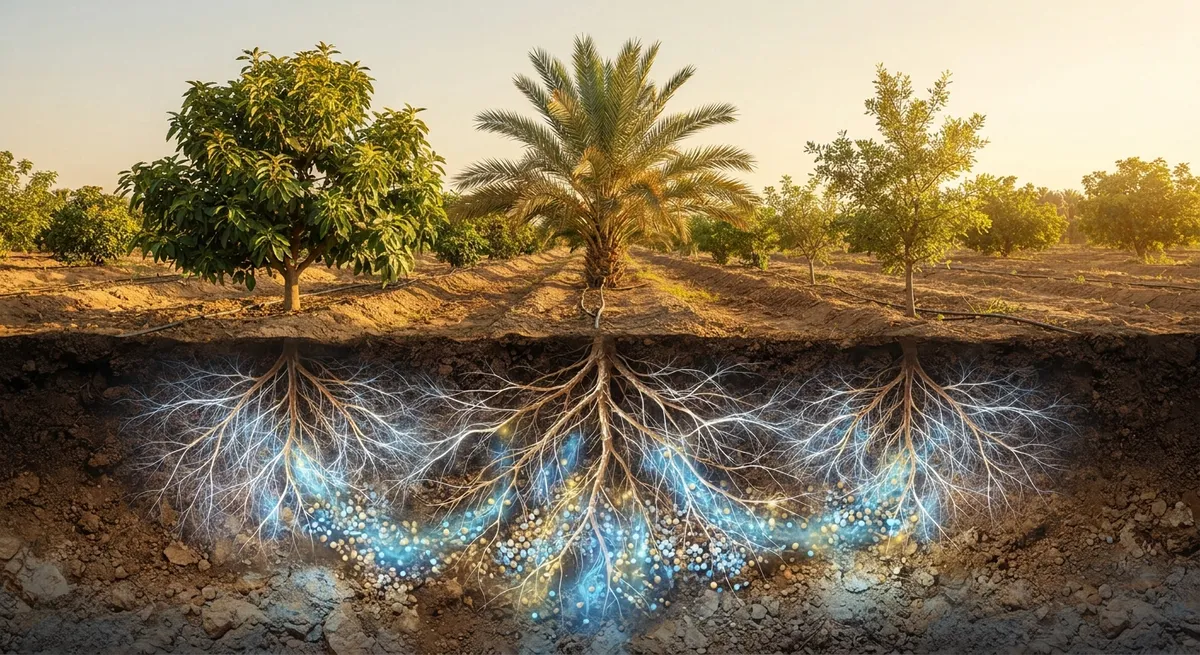
The soil cause: phosphorus fixation and poor diffusion
Although Morocco is a world leader in phosphate resources, phosphorus use efficiency (PUE) in the field often remains limited. In calcareous soils (high pH), plant-available orthophosphate ions (HPO₄²⁻ and H₂PO₄⁻) quickly precipitate with calcium (Ca²⁺) into insoluble calcium phosphates, while in more acidic soils they are adsorbed onto iron (Fe³⁺) and aluminium (Al³⁺) oxides.
Beyond this fixation, phosphorus has an extremely low diffusion coefficient in the soil solution: the root only takes up phosphorus from a narrow depletion zone a few millimetres around it. This is a major constraint in Morocco's main farming regions:
- Avocado (Gharb and Loukkos plains, Larache, Kenitra, Moulay Bousselham): The avocado has a shallow root system without functional root hairs and is very sensitive to water stress and to saline irrigation water.
- Date palm (Errachidia, Boudnib, Erfoud, Zagora, Ouarzazate, Tata and Figuig): In the oases of Tafilalet and the Drâa valley, salinity, calcareous oasis soils and heat stress cause rapid phosphorus fixation, hurting fruit set and fruit size (notably on the Medjool variety).
- Argan (Souss-Massa, Agadir, Taroudant and Tiznit): On the arid, stony, calcareous soils of south-west Morocco, an efficient root symbiosis in the rhizosphere is decisive for plant establishment, vegetative growth and fruiting.
Agronomic synergy in the rhizosphere: mobilise and transport
To lift both the chemical lock-up and the poor mobility of phosphorus, a dual action in the rhizosphere is essential. Research shows that applying stabilised orthosilicic acid (OSA) together with arbuscular mycorrhizal fungi (AMF) creates a synergy that can increase the crop's phosphorus uptake by up to 89%:
Chemical desorption and plant physiology with Orthagrow Granulé
Bioavailable monosilicic acid (H₄SiO₄ / OSA) competes, through ligand exchange, for the same adsorption sites on soil minerals as phosphate ions. It thereby desorbs fixed phosphorus and releases it into the soil solution. Inside the plant, OSA regulates the expression of phosphate transporters (notably the Pht1 family), stimulates root exudation of organic acids and strengthens epidermal cell walls through amorphous silica deposits. This improves osmoregulation and eases abiotic stress (drought, heat stress and salt-related ion toxicity), keeping transpiration flow and mineral uptake going.
Biological solubilisation and root extension with MYCO4G
The selected consortium of endomycorrhizae in MYCO4G forms a mutualistic symbiosis with the root. The network of extraradical hyphae makes up for the avocado's lack of root hairs and is essential for fast root colonisation of young tissue-culture date palms and argan plants in arid, saline conditions. These microscopic filaments explore the soil well beyond the root depletion zone, secrete acid and alkaline phosphatases and organic acids to mineralise locked-up phosphorus, and pass orthophosphates directly to the root's cortical cells.
From science to agronomic performance in the field
By adding Orthagrow Granulé and MYCO4G to the fertilisation programme, growers trigger a self-reinforcing mechanism: OSA mobilises fixed phosphorus and strengthens tolerance to abiotic stress, while the endomycorrhizae multiply the root absorption surface. The result is significantly higher yields, faster establishment of young plantings and better harvest quality, while making phosphate fertilisers more efficient.
Practical questions (FAQ)
Soil salinity or water stress problems?
Combine Orthagrow Granulé with MYCO4G: orthosilicic acid (OSA) desorbs phosphorus locked up in calcareous and saline soils while improving osmoregulation against drought, and arbuscular mycorrhizae carry water and orthophosphates to the roots up to 89% more efficiently.
How to tackle salt stress and weak root growth in avocado (Gharb, Loukkos)?
The avocado has no functional root hairs and is highly sensitive to salinity and water shortage. MYCO4G builds a dense network of extraradical hyphae that multiplies the root absorption surface, while Orthagrow Granulé strengthens cell walls and limits salt-induced ion toxicity.
How to get larger dates and reduce young palm mortality (Errachidia, Zagora)?
In palm groves exposed to salinity and intense heat, MYCO4G ensures fast mycorrhization of young tissue-culture plants and deep exploration for water and phosphorus. Combined with Orthagrow Granulé, it protects palms against heat and salt stress, supporting fruit set and date quality.
How to help young argan trees establish on the poor, arid soils of Souss-Massa?
The argan tree relies heavily on endomycorrhizae for its mineral and water nutrition in semi-arid conditions. Applying MYCO4G and Orthagrow Granulé together at planting or as maintenance unlocks fixed phosphorus and extends the root network for vigorous rooting.